
Marketing Content Strategy
Growth Marketing


Are content marketing challenges causing your company to miss revenue targets?
In 2026, content marketing is harder to execute well than ever. Teams are balancing AI-assisted and human-generated content, publishing across more channels, and facing more pressure to prove marketing ROI. Many are creating more content without generating more pipeline.
I think about these challenges through my Cloudworker superhero persona: a creative way to frame the real work of content strategy, lead generation, SEO, AEO, sales enablement, and revenue-focused storytelling. According to HubSpot’s 2026 State of Marketing Report, marketers identified five major challenges:
Let's explore all of the challenges you should be wary of as a content marketing leader, that you really must address.
Here are a few broader trends help explain why these problems feel so intense right now:
That means more content, more complexity, more pressure, and more chances for things to break.
Do these challenges seem familiar? In 2025, marketers prioritized generating traffic above all, and hiring top talent was displaced by marketing trends and platforms. Sales and marketing alignment pushed driving purchases off the list this year. Creating a cohesive "smarketing" division (aligned sales and marketing) is a top goal for marketers which empowers them to drive more revenue than siloed teams.
Recently, been reading a book called "Marketing Superpowers" by Jon Davids, the CEO of Influicity, a Toronto-based digital agency. Just as I started questioning whether portraying my content marketing abilities with a superhero character, this book crossed my radar. I was inspired by Jon's book to publish this article I wrote, and share it with you. Every superhero needs villains to overcome to wield their powers upon, and test their limits.
HubSpot’s report also highlighted a few trends worth paying attention to in 2026. Most marketers are now using AI in content creation. Many are publishing across five or more channels. A large share review performance weekly or even daily. And for many teams, the website remains the most-used marketing channel. That combination creates pressure: more content, more channels, more measurement, more expectations. No wonder so many teams feel like they’re fighting supervillains.
Let’s meet them.

The Green Gobbler isn't actually green, he just makes the "long green" (AKA revenue) disappear from your marketing P&L reports. He undermines your team's hard work with inept attribution tactics, and makes it impossible to attribute the revenue generated by your marketing assets with inaccurate reporting or even made-up numbers.
He thrives in bad attribution models, incomplete reporting, and dashboards full of vanity metrics. Your team launches campaigns, publishes content, supports events, runs email nurtures, and generates engagement — but when leadership asks what drove revenue, the answer gets fuzzy fast. Suddenly sales gets all the credit, marketing gets all the scrutiny, and nobody can say with confidence what’s working.
This is one of the most dangerous villains in content marketing because it doesn’t just hurt performance. It hurts decision-making. If you can’t connect content and campaigns to pipeline, you can’t invest intelligently. You end up overfunding weak tactics, underfunding strong ones, and having internal arguments about opinion-based performance instead of making judgements based on hard evidence.
Realizing and tracking marketing ROI requires disciplined attribution. That means stronger campaign structure, better CRM hygiene, clearer source tracking, and a more realistic view of how content influences revenue across the buying journey. I’ve worked with platforms like HubSpot, Salesforce, and Microsoft Dynamics to connect campaigns, content assets, and lead activity to actual business outcomes. When attribution improves, so does executive trust.
The Green Gobbler loses power the moment marketing can prove its impact on business growth and profitability.

FOMO Frenzy is fast. Too fast.
One minute your team is refining a sensible content strategy. The next, you’re evaluating three new AI writing tools, debating whether to launch on another platform, reacting to a search update, and attending a webinar about a trend that may not matter six months from now.
She feeds on a familiar fear: What if we’re falling behind
That fear leads teams to overextend themselves. They try to publish everywhere, test everything, subscribe to everything, and chase every “must-have” tactic. The result is rarely innovation. It’s usually fragmentation. Productivity drops, strategic focus disappears, and content quality starts to suffer because everyone is too busy reacting to build anything durable.
I've learned (sometimes the hard way) to ignore wading into the quicksand-like oceans of information about the galaxies of martech tools and tactics available in the age of AI. There are many flashy objects that can distract marketing professionals, and send them scurrying down rabbit holes all day. It can be a real drain on your team's productivity.
I stay (as much as possible) on top of the emerging tools and updates for your company's leadership team. I can evaluate tools for you, and share what you need to know in digestible ways. Or, I can typically find things out via the communities and resources I'm connected to.
FOMO Frenzy slows down when a marketing team has a roadmap, a clear point of view, and the discipline to ignore distractions that don’t support revenue goals.

That’s rarely just a traffic problem. It’s a content and systems problem.
Good content reduces friction. So do better forms, sharper CTAs, clearer intent signals, and workflows designed around how real buyers behave. I think about this challenge as the intersection of messaging, UX, automation, and demand generation. When those pieces work together, you don’t just generate more responses — you create a cleaner path from interest to pipeline.
Dr. Friction retreats when the journey feels simple, relevant, and worth completing.
As The Cloudworker, I can help you build digital content, multi-step portal forms, and communications assets that combine EEAT-focused content (expertise, experience, authoritativeness, and trustworthiness). I can apply what I've learned about smart AEO and SEO strategies, so your brand consistently shows up as the best-qualified answer in search, LLM and AI engines. And, I can interview your subject matter experts and capture their expertise into concise, shareworthy content.

The Polarizer doesn’t need mind control. He just needs team misalignment and competing priorities. He shows up when sales and marketing operate from different definitions of a qualified lead. When product launches without enough messaging support. When customer service hears recurring objections that never make it back into content strategy. When finance wants efficiency, but nobody can clearly explain marketing’s role in growth.
Silos don’t just create internal frustration. They create external confusion. Buyers feel it in inconsistent messaging, missing enablement assets, poor handoffs, and disconnected customer experiences.
Some of the best content opportunities inside a business don't come from a writer's brainstorm in isolation. They come from collaboration. They come from sales conversations, support issues, product questions, implementation challenges, and customer success wins. When those insights stay trapped inside departments, your content gets weaker and your go-to-market motion gets noisier.
I do my best work with companies that want sales and marketing to act like partners, not rival kingdoms. The more aligned your teams are, the more useful your content becomes — not just for awareness, but for deal progression and customer trust.
The Polarizer loses power the moment teams start sharing goals, and wins instead of assigning blame, and unfairly claiming credit.
I have witnessed the impact of siloed departments like these, and they weren't caused by a brick monster. Instead, they are often created by poor interdepartmental communications, a lack of sales enablement content, unclear product roadmaps, or workflows that are too complex, or undocumented. I do my best work with companies that foster collaboration between their sales and marketing divisions. They use tools like HubSpot, Asana, Slack or Microsoft Teams to facilitate internal and external collaboration.
I can help your business to bring your salespeople and customer service agents to the table to share experiences we can distill into authority-building content. Many of your best storytelling opportunities come from customer problems and real-life use cases of your products and services.
ClawBack and RIFMaster - The Budget Slashers
HubSpot identified budget pressure as one of the top five marketing challenges in 2026. In reality, it often shows up with a sidekick.
ClawBack cuts campaign budgets. RIFMaster cuts capacity. Together, they force marketing teams to do more with less.
And yet the demands don’t go away:

This is where lean content strategy matters. Companies do not always need larger teams. They do need focused execution, reusable assets, and content tied to revenue priorities.
I’ve built a lot of my Cloudworker brand around this reality: helping companies maintain momentum without bloated production systems.
ClawBack represents the fifth challenge from HubSpot's 2026 State of Marketing report - securing marketing budgets. Precious funding for product launches, rebranding campaigns, and growth marketing initiatives. What marketing budgets reduced year over year, or even mid-year when revenue and economic conditions dictate it?

You've undoubtedly heard about or experienced businesses reducing headcount, or cutting back budgets on non-essential spending.
RIFMaster is ClawBack's partner in go to market crime. He represents the impact of layoffs across the go-to-market team. Your marketing team has likely lost colleagues due to changing priorities and fluctuating budgets. If your team is reduced, a fractional contractor can help you meet deadlines until your team is right-sized again.
When ClawBack slashes the budget and RIFMaster storms through the go-to-market team, most companies face the same brutal reality:
Marketing and sales pipelines still need content fuel
Brands still needs a clear, consistent voice
The sales team still needs resources like on-brand presentations, collateral, and playbooks.
When budgets tighten and headcount is reduced, the expectations on marketing rarely change. Companies still need to sustain brand visibility, support the sales organization, and generate pipeline, but they often have fewer internal resources to do so. In that environment, I can provide flexible support as a freelance content writer on either a project basis or under a monthly retainer. This allows companies to maintain consistent output across blogs, case studies, landing pages, thought leadership, email campaigns, and sales materials without taking on the fixed cost of an additional full-time hire.
My skills extend beyond content production. I bring experiences across digital marketing, content marketing, sales enablement, SEO, and AEO. It allows me to contribute at both the executional and strategic levels. That means I can help strengthen messaging, improve search visibility, support lead generation, enhance conversion paths, and create content that is aligned with business goals and sales priorities. Instead of hiring several people to do less work, my skillset can address a broader spectrum of responsibilities.
-1-1.png?width=541&height=295&name=Gemini_Generated_Image_bwe42cbwe42cbwe4%20(1)-1-1.png)
The AI SlopMonster is not AI itself. It’s what happens when AI content gets used without strategy, standards, or taste.
This villain appears when teams confuse speed with quality. They publish more, but say less. The content becomes readable, searchable, and completely forgettable.
You’ve seen it:
That kind of content weakens trust. It makes brands sound interchangeable. It kills the authority that strong content marketing is supposed to build.
AI can absolutely support smart content production. But it still needs human judgment, subject matter expertise, and editorial direction. The best AI-assisted content still sounds like a real person with real experience wrote it.
I can keep the AI SlopMonster at bay with organic or AI assisted content that maintains your brand standards.

Alias - Lydia Cross
Claim to Fame - The Website Entangler
Powers - Breaks internal link structures, buries key pages under confusing navigation, and creates dead ends that trap visitors and starve search engines of crawl equity
Vulnerabilities - Site audits, intuitive information architecture, and a disciplined internal linking strategy
Comic Inspiration - DC's Catwoman
Lydia Cross was a promising UX architect until she was transformed during a late-night site content migration. She was changed into a feral beast when she drank tea infused with an exotic blend of Peruvian catnip, and rare orchid pollen. Now she is HyperLynx. She doesn't destroy websites as much as tangle them into an impossible cat's cradle of hopeless navigation and no search capability. She adds dropdowns to the nav that don't connect to content that will satisfy your prospect's curiosity. She lets the 404s pile up after a rebrand. She severs the internal links that would have passed authority from your traffic-heavy blog posts down to your money pages. Her work is invisible until it's catastrophic.
HyperLynx doesn’t ruin websites outright. She entangles their internal linking structure, and prevents visitors and search spiders from navigating to their most valuable content.
She shows up in:
This is one of the most overlooked SEO and AEO problems in modern content marketing. A site can have strong content and still underperform if the structure is working against both users and crawlers.
When visitors can’t find the next step, bounce rates rise. When search engines can’t understand page relationships, authority gets trapped in the wrong places.
A strong content strategy needs a strong site structure behind it. HyperLynx loses when the website becomes easier to navigate, easier to crawl, and easier to convert on.
.png?width=1376&height=768&name=Gemini_Generated_Image_b3sy6kb3sy6kb3sy%20(1).png)
Alias - Jacques de Blais
Claim to Fame - The Search Shapeshifter
Powers - Renders yesterday's SEO strategy obsolete overnight, penalizes content that once ranked, and sends organic traffic into freefall without warning
Vulnerabilities - Buyer intent research, evergreen content architecture, and E-E-A-T principles
Comic Inspiration - DC's The Joker
Jacques de Blais failed in his attempts to bend the SERPs to his will as a black beret SEO. Frustrated, he broke into a data center cooling water tank, and was transformed into the Algorithmime. He doesn't break your website. He doesn't steal your budget. He just changes the rules of AEO and SEO discoverability. He quietly, and gleefully manipulates the rules of getting found online, right after you've spent six months optimizing for the old ones.
He is the living embodiment of every core update, ranking factor reversal, and helpful content rollout that ever vaporized a content team's hard work overnight. One quarter your pillar page sits at position one. The next, it's on page four, displaced by a Reddit thread and a YouTube video. Your team scrambles to diagnose what changed. Was it the keyword density? The page speed? The backlink profile? Algorithmime just laughs. He doesn't explain himself. That's the point.
Algorithmime changes the rules right after you finally learn them.
One quarter your content ranks. The next, it drops behind forums, videos, AI summaries, and new SERP features. Teams start scrambling for explanations and quick fixes.
That reaction is exactly what Algorithmime wants.
The real issue is that search and AI engines are getting better at detecting shallow, formulaic content. Content built for algorithms alone is easier to spot. Content built around real expertise, buyer intent, and information gain tends to hold up better.
That’s why I focus on content strategy that is grounded in audience questions, clear structure, and genuine subject matter depth. Good SEO and AEO today require more than optimization. They require substance.
Alias - David Doron III
Claim to Fame - The Pipeline Phantom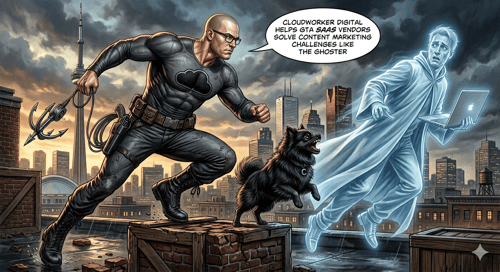
Powers - Turns warm opportunities into silent deals that never close
Vulnerabilities - Sales enablement content, internal champion tools, and business-case assets
Comic Inspiration - DC's Gentleman Ghost
David Doron was a charming, well-dressed prospect. He attended your executive roundtable, and a few webinars. He downloaded your pricing guide. He responded to two follow-up emails and asked thoughtful questions on the discovery call. He even said — and you wrote this down — "let's reconnect after the holidays."
That was four months ago.
The Ghoster doesn't slam doors, spew slime, or vanish and reappear nearby. He simply becomes translucent — present enough in your CRM to inflate your pipeline, absent enough that nothing closes. He is the deal that's been in "negotiation" for months, then went quiet after promising to loop in their VP. The prospect who attended a second demo and then vanished into the organizational ether, taking your carefully crafted proposal with him.
The Ghoster is difficult to combat because he doesn't always act alone. Sometimes he wants to move forward but lacks the internal autonomy to do so. He can't get budget approval without an ROI model. He can't get his CFO in the room without an executive summary that speaks finance, not features.
Sometimes deals don’t die because interest disappears. They die because your buyer lacks the tools to sell your value internally.
They need:
This is why sales enablement content matters. Great top-of-funnel content gets attention. Great late-stage content helps deals close. The Ghoster becomes much less dangerous when your content keeps working after the sales conversation starts.
Content and sales enablement strategies often break down when they aren’t strategic, specific, and aligned to the full buyer journey.
That’s the common thread behind weak marketing ROI, poor lead generation, SEO volatility, AI content issues, and pipeline friction. Companies rarely lose because they created too little content. They lose because the content wasn’t structured to support discovery, conversion, sales conversations, and trust at the same time.
That’s the battle I think about most as Mark Burdon, the Cloudworker.
None of these villains are invincible. Here's how they can be overcome:
If your content marketing strategy feels like it’s under attack, it probably is — by a mix of weak systems, unclear messaging, channel overload, and content that isn’t tied closely enough to revenue.
The Legion has been winning long enough. Time to send in the Cloudworker.
Get the Cloudworker on your marketing team